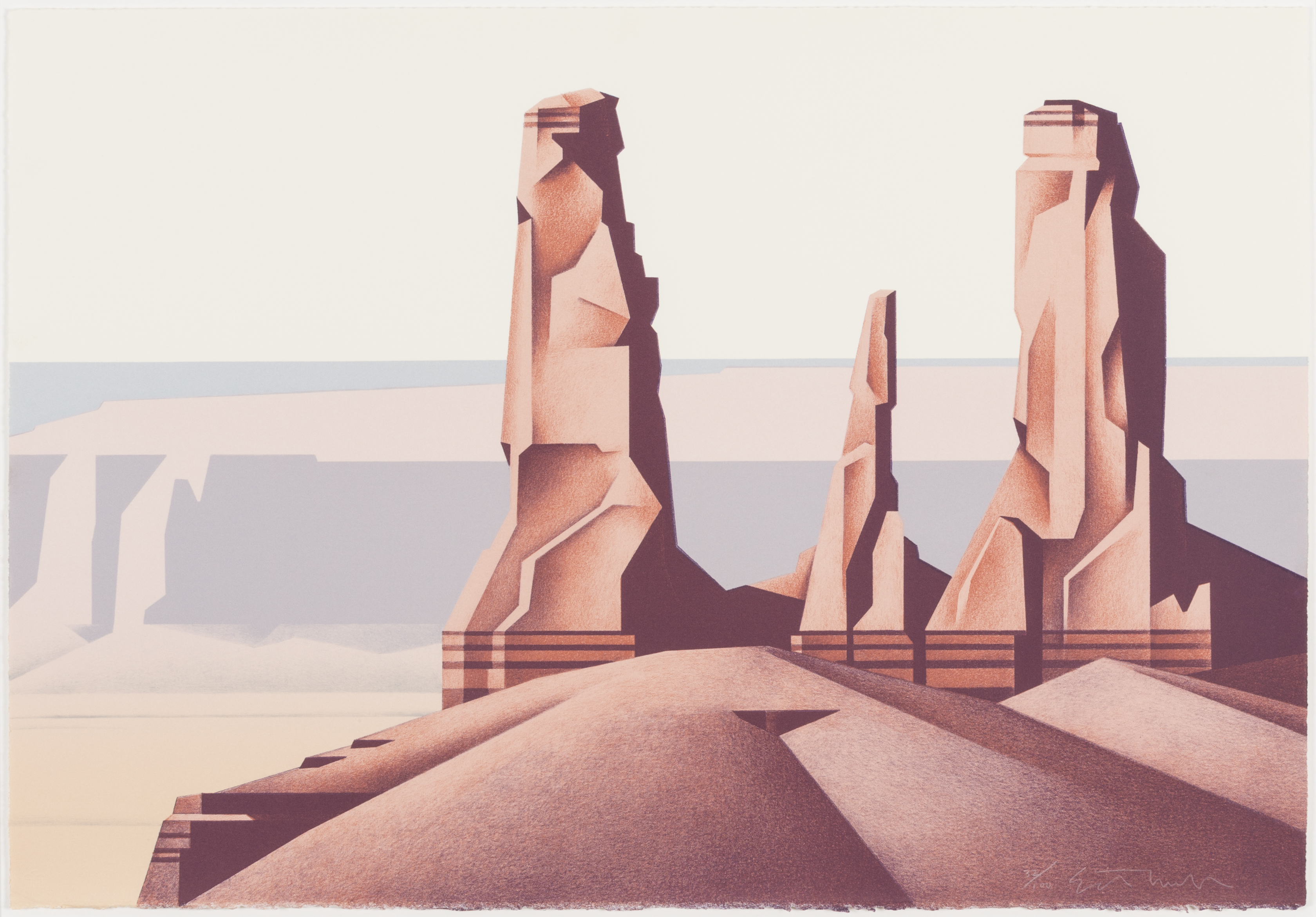
CAPTION: “Desert Perspectives” will open on September 19 at Scottsdale Museum of Contemporary Art (SMoCA). “Three Sisters” by Ed Mell will be among the featured artworks.
SCOTTSDALE, Ariz. — Scottsdale Museum of Contemporary Art (SMoCA) presents “Desert Perspectives,” a year-long, collection-centered exhibition drawing from artwork in the museum’s permanent collection, alongside loans and new commissions, opening on September 19.
The exhibition brings together a multigeneration group of artists, working in or regionally connected to the Southwest, whose practices engage the desert not only as a physical landscape but as a layered site of cultural and ecological significance.
Each artwork offers its own narrative as an individual viewpoint, and, when seen in sequence, builds upon the others. The exhibition examines the shifting perspectives of how the desert of the Southwest has been imagined, represented, inhabited and transformed over time.
Curated by Keshia Turley, SMoCA assistant curator, “Desert Perspectives” grew out of the curiosity of placing historical landscape works in conversation with more contemporary artworks. The result became an interconnected dialogue on the landscape, both visually and culturally, that continued to grow through a framework of how artworks across time can inform, complicate or reshape one another.
“'Desert Perspectives’ began with a desire I had to reconsider the deserts of the Southwest, beyond the familiar visual and symbolic tropes that so often define them,” Turley said. “The desert occupies a powerful place in the cultural imagination and, like many landscapes, has been deeply mythologized. The reality, though, is a lot more nuanced.”
To Turley, focusing on this specific desert landscape is especially urgent as someone who inhabits and loves the region. The Southwest is a place where many of the issues shaping public consciousness and their impacts — like climate change, resource extraction, migration and land use — are acutely visible and felt.
At the same time, the Southwest holds profound personal and cultural significance for many of the artists in the exhibition, including Jen Urso, Hyewon Yoon, Mark Klett, Ed Mell, Lon Megargee, Ellen Wagener, George Elbert Burr, Gerard Curtis Delano, Billy Schenck, Matt Magee and Fritz Scholder.
“Desert Perspectives” unfolds through three sequential rotations, each introducing a new perspective lens through works from the collection. A core group of loaned and commissioned works will remain on view throughout the exhibition, creating an ongoing dialogue across a lineage of historical and contemporary approaches to the region. Conceptually, the rotating structure mirrors the exhibition’s understanding of the desert as an environment continually shaped, while inviting visitors to consider how narratives of place shift depending on context, viewpoint and time.
“The perspectives or rotations can stand as individual viewpoints or build upon one another if seen in sequence,” Turley said. “Together, they suggest that the landscape surrounding us can’t — and shouldn’t — be reductive but instead exists as a dynamic intersection of representation, ecology, memory and lived experience.”
A central throughline of the exhibition is understanding that the desert is not static. Artistic and cultural narratives have long shaped how the landscape is imagined and understood, while ecological realities and human presence continue to transform it in ways that are both subtle and irreversible. In this sense, the desert, much like all landscapes, becomes a record of challenged imaginaries, intersecting histories and ongoing negotiations.
“I think it’s easy to take it for granted or see it as peripheral instead of recognizing it as a site of density, meaning, activity and interconnection," Turley said. “My hope is that the desert becomes less of a distant backdrop and more of an active presence. Ultimately, it isn’t my intent to offer a singular redefinition of the desert — far from it. Rather, it’s my attempt to encourage a more nuanced, attentive and expansive way of seeing.”
“Desert Perspectives” is organized by Scottsdale Museum of Contemporary Art (SMoCA) and curated by Keshia Turley, assistant curator.
SMoCA — named “Best Art Museum” in the Best of Phoenix awards — is located at 7374 E. Second St., Scottsdale, Arizona 85251. It is open Wednesdays, Fridays, Saturdays and Sundays, 11 a.m. to 5 p.m., and on Thursdays, 11 a.m. to 7 p.m. Visit SMoCA.org for information.
Admission is $16 for non-members; $13 for students, seniors (65+) and veterans; and free for Scottsdale Arts ONE Members, healthcare workers, first responders, and patrons 18 and younger. Admission to the museum is pay-what-you-wish every Thursday and every second Saturday of the month.
MEDIA CONTACT: Sydney Ritter | SydneyR@ScottsdaleArts.org | 480-874-4663