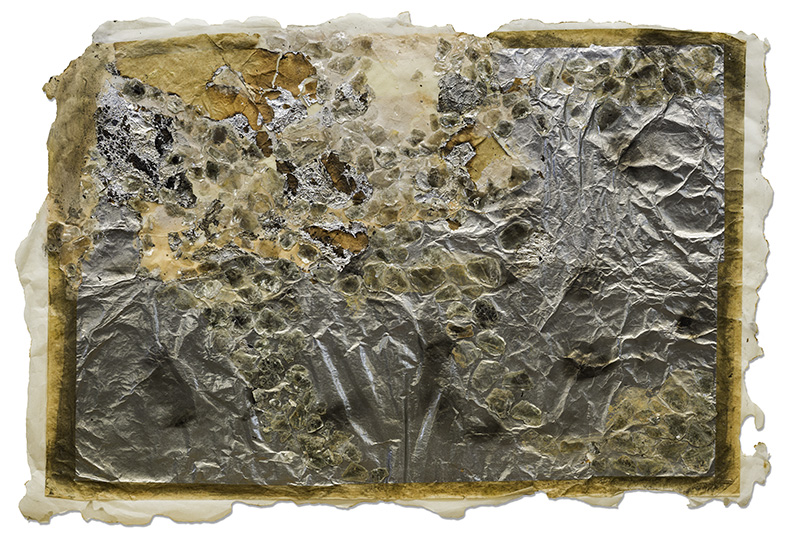
CAPTION: Beth Ames Swartz, “Transformations, Mica #3,” 1977. Mica, fire, ash, acrylic, silver leaf, and mixed media on layered rice paper, 23 × 32 inches. Courtesy of the artist. Photo: John Dowd.
SCOTTSDALE, Ariz. — Opening March 21 at Scottsdale Museum of Contemporary Art, “Tender Alchemy: Beth Ames Swartz and Julianne Swartz” presents the works of mother and daughter artists whose distinct practices are united by a shared devotion to transformation, healing and the invisible forces that shape human experience.
“Tender Alchemy” marks the first time their works are presented together, offering an intimate look at how two generations engage in artistic “alchemy” through distinct materials and methods.
“Our goal with this exhibition is to create a space where their unique yet harmoniously aligned practices speak across generations, revealing both the similarities and differences in their shared focus on spiritual and material transmutation,” said Lauren R. O’Connell, curator of contemporary art at SMoCA, who curated this exhibition. “Bringing their works into dialogue feels like facilitating an energetic convergence of two artists whose lives and practices have always been intertwined.”
For more than 60 years, Beth Ames Swartz, who was born in 1936, has devoted her practice to spiritual inquiry and personal evolution. Her layered, luminous paintings act as meditative spaces.
Beth received significant national attention for her fire work early in her career, from the mid-1970s through the early 1980s, resulting in a New York museum show and much press attention. She moved away from her popular fire work to explore new methods of making.
“Tender Alchemy” premieres the first collaboration between mother and daughter, bringing together "Quantum Light," the newest body of work by Beth Ames Swartz, and "Gateway," a new soundscape by Julianne Swartz, uniting their visual and sonic languages.
Julianne Swartz, who was born in 1967, said she once thought her own artistic practices were quite different from her mother’s, but she now sees strong alignments: unconventional processes, deep material transformations and a commitment to experiential and philosophical content.
“Witnessing my mom’s art practice gave me permission to be courageous and experimental in my own practice,” Julianne said. “From my perspective as an adult, and as a fellow artist, I see how brave and bold her work was and still is.”
Julianne’s art practice synthesizes sound, light, energy and other matter into participatory experiences that are both intimate and expansive. Her sculpture and site-specific installations invite tactile, auditory and affective engagement.
“Tender Alchemy” will include Julianne’s new and recent sculptures made from materials like clay, copper, glass and sound, forming finely tuned, multisensory instruments. Balancing opposites — soft and hard, still and kinetic — they are designed to produce physical and psychological effects.
“I love beauty and visual form, but that in itself is not enough,” Julianne said. “I want my work to be and do more to induce more awareness, attention, focus and embodiment in another person. Physical materials are very important in my practice, but I am also sculpting non-physical elements: energy and attention.”
The exhibition also includes a survey of Beth’s fire works and paintings, spanning more than 60 years of her abstract interpretations of wisdom systems. “Tender Alchemy” provides a deep exploration of her lifelong commitment to studying and expressing esoteric and holistic philosophies, from Jewish mysticism to shen qi from the qigong medical tradition. More recently, her art has begun to investigate the spiritual dimensions of quantum theory.
“What I hope will be achieved is the audience will see that all works are commonly informed by philosophical and spiritual concepts shared by people of different cultural worldviews and often incorporate both symbols and words in the vocabulary of their visual language,” Beth said. “Uniting my art is its conceptual inspiration rather than a consistent visual style.”
Together, the work of these artists forms a cross-generational dialogue, grounded in tenderness, perception and transformation. While their methods differ, their intentions echo across time and space, offering complementary visions of how art can serve as a bridge between worlds.
A catalog, co-published with Hirmer, will accompany the exhibition with essays by Susan L. Aberth, Nancy Princenthal, and O’Connell. In her essay for the catalog, O’Connell writes:
“The differences between their practices are as instructive as their affinities. Beth’s art is maximalist, saturated, and layered with meaning and color, striving toward symbolic depth. Julianne’s work is minimalist, ephemeral, and fragile in its neutrality. One accumulates density; the other cultivates restraint. Yet both share a willingness to surrender control to process, allowing intuition and material to guide them.”
“Tender Alchemy” also reflects O’Connell’s ongoing commitment as a curator to highlighting significant Arizona artists like Beth Ames Swartz. O’Connell previously co-curated a major exhibition at SMoCA featuring the works of Dorothy Fratt. She noted that both artists’ contributions have profoundly shaped Arizona’s cultural landscape.
“Tender Alchemy: Beth Ames Swartz and Julianne Swartz” is organized by Scottsdale Museum of Contemporary Art and curated by Lauren R. O’Connell, curator of contemporary art. Support provided by World Class Sponsor Sarah and JT Marino, Signature Partner Ann B. Ritt Charitable Foundation, Signature Sponsors Jill M. Brown, Richard Corton, Nancy and Michael Gifford, Diane and Gary Tooker, and an anonymous donor, and Supporting Sponsors Jane and Mal Jozoff, Sally and Richard Lehmann, and an anonymous donor.
SMoCA is located at 7374 E. Second St., Scottsdale, Arizona 85251. It is open Wednesdays, Fridays, Saturdays and Sundays, 11 a.m. to 5 p.m., and on Thursdays, 11 a.m. to 7 p.m.
Admission to the other galleries is $13–$16 for non-members; $10–$13 for students, seniors (65+) and veterans; and free for Scottsdale Arts ONE Members, healthcare workers, first responders, and patrons 18 and younger. Admission to the museum is pay-what-you-wish every Thursday and every second Saturday of the month. Find more information and purchase admission online at SMoCA.org.
MEDIA CONTACT: Brian Passey | BrianP@ScottsdaleArts.org | 480-874-4626