The History of Cattle Track
A Storied Past Rooted in Creativity
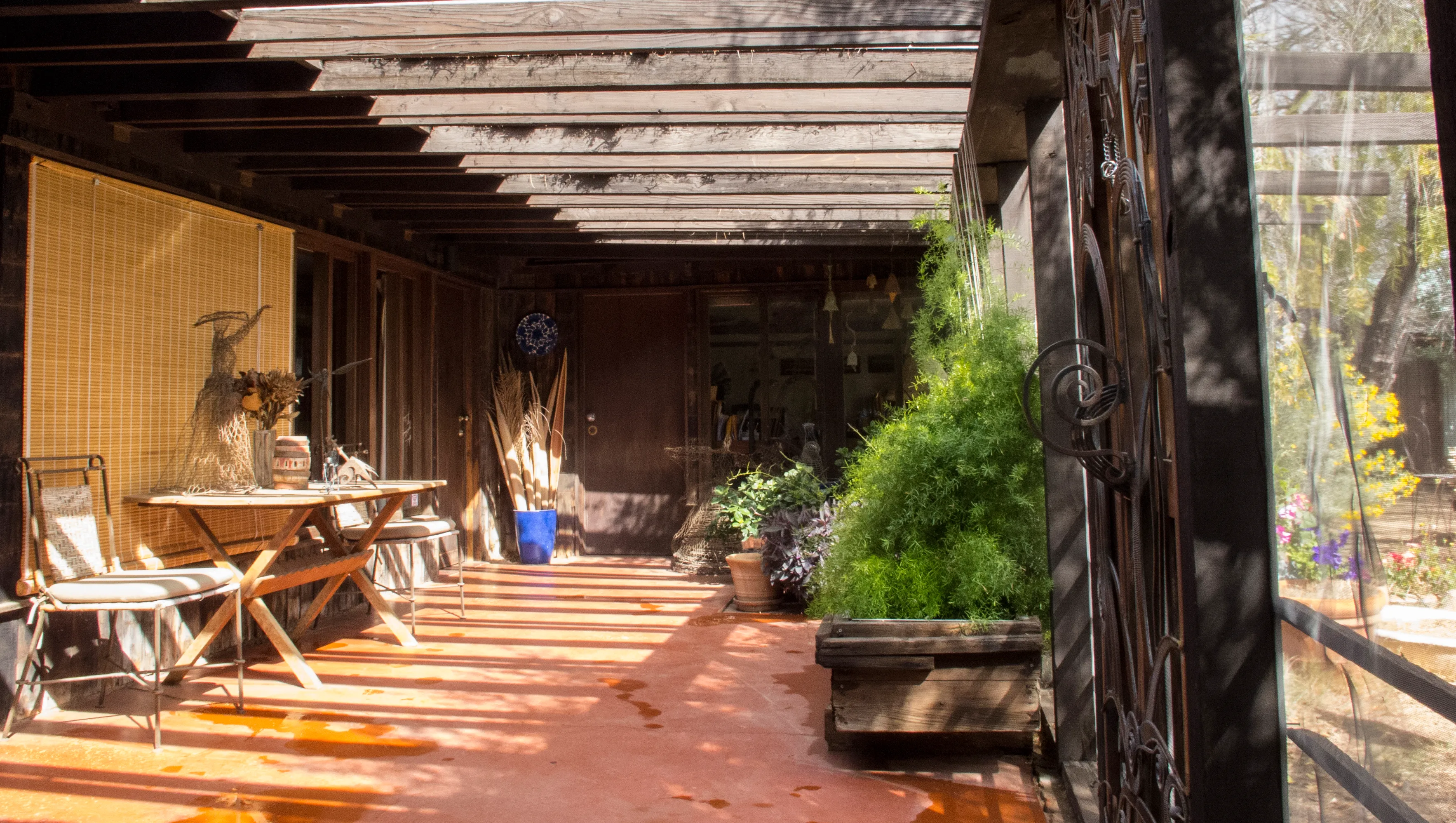
Cattle Track began in 1937 as the 10-acre homestead of George and Rachael Ellis. At the time, the surrounding area was open desert, with the nearby Arizona Canal serving as one of the only signs of civilization. Cowboys often drove cattle along the canal, giving the area its “Cattletrack” nickname. Today, the road that fronts the compound still carries that name. In 1999, Cattle Track was added to the National Register of Historic Places.
George Ellis built the first structure on the land using reclaimed redwood from an abandoned water pipeline. It began as a one-room home, which he later expanded and complemented with a bunkhouse. Today, the compound includes a dozen buildings, including the original Ellis House and the longtime residence of renowned Arizona painter Philip C. Curtis.
From its earliest days, the compound has welcomed free-spirited, multidisciplinary creativity and fostered a strong sense of community among artists and thinkers. Revered Arizona artists like Curtis and Fritz Scholder lived at or near Cattle Track. Sculptor Louise Nevelson and future Supreme Court Justice Sandra Day O’Connor were also frequent visitors. The Ellises themselves filled the compound with creative pursuits—George through his building projects, Rachael through fabric art and costume design, and their son David, who crafted fiberglass racecar bodies on-site, including one driven by Mario Andretti to victory at the 1969 Indy 500.
Today, the family legacy lives on through their daughter, Janie Ellis, who continues to champion the creative spirit of Cattle Track and guide its evolution as a home for bold ideas and artistic freedom.